
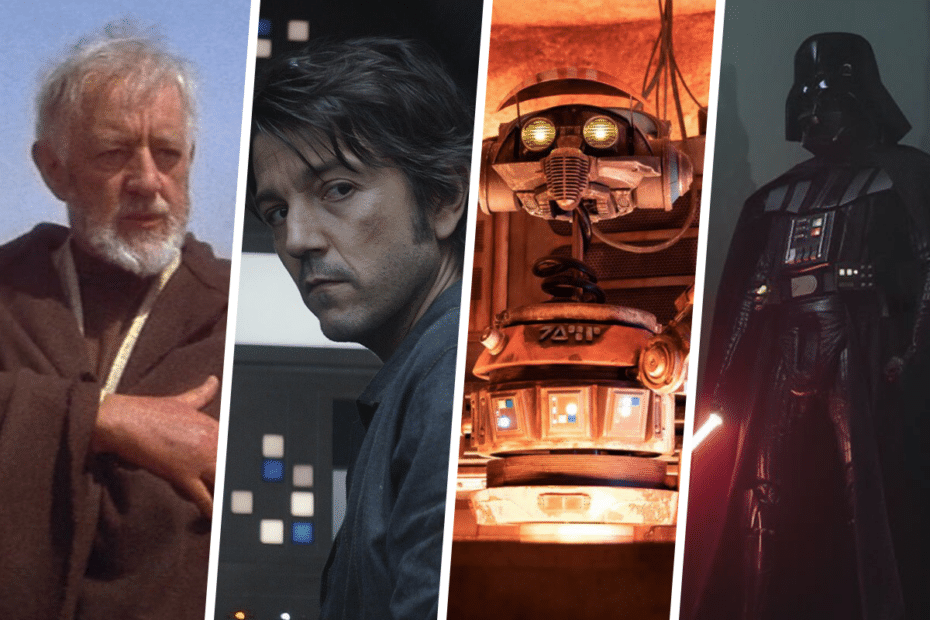
Star Wars is a space opera, a subgenre of science fiction that emphasizes melodramatic adventure, heroic characters, exotic worlds, and epic conflicts over scientific accuracy. But that label barely scratches the surface.
George Lucas himself has rejected the sci-fi label on several occasions, calling Star Wars a “fantasy film… and a space opera“. The magical Force, space wizards, and fantastical beasts are closely associated with fantasy stories, not science fiction.
Actually, the Star Wars saga draws inspiration from many different genres. You can also see aspects of planetary romance, science fantasy, space westerns, military science fiction, high fantasy, and sword and sorcery in different movies and shows.
So calling Star Wars sci-fi alone is a gross oversimplification. And pinning it down to any single genre misses what makes the franchise so unique.
This guide answers what genre is Star Wars, defines every genre that influences Star Wars, and classifies each canon film and TV show by its specific genre identity. We’re focusing on canon films and TV series only, excluding Legends material, books, and comics.
Is Star Wars Science Fiction or Fantasy?
Depending on your point of view, Star Wars is both science fiction and fantasy. Similarly, it can be described as a fantasy story set in a science fiction universe, often labeled as space opera or science fantasy. These are two distinct genres of speculative fiction that are interconnected in Star Wars.
When we argue about whether Star Wars is sci‑fi or fantasy, we’re really arguing about genre labels. A genre establishes the expectations for what the audience will get from the story.
When something is science fiction, you might think of getting digitized and playing on a game grid, like in Tron. And with fantasy, you are picturing wizards and dragons, like Lord of the Rings.
Generally, science fiction focuses on advanced technology and future civilizations, whereas fantasy deals with magic, adventures, and epic quests. The starships, lightspeed, lightsabers, aliens, and droids tend to fall more into science fiction. However, the Force, the Jedi and Sith, and much of the world-building tend to relate more to fantasy.
Thankfully, George Lucas has been remarkably consistent about where he thinks Star Wars falls.
What George Lucas Said About Star Wars’ Genre
In a 1977 Rolling Stone interview, Lucas explained his approach to the original film: “I was afraid that science-fiction buffs and everybody would say things like, ‘You know there’s no sound in outer space.’ I just wanted to forget science.” He went on to say he “wanted to make a space fantasy that was more in the genre of Edgar Rice Burroughs; that whole other end of space fantasy that was there before science took it over in the Fifties.”
Lucas made this even more explicit in later years. At the 2015 Sundance Film Festival, he told the audience, “Star Wars isn’t a science-fiction film, it’s a fantasy film and a space opera.” He added, “I really have no interest in science fiction at all.”
In a conversation with James Cameron for James Cameron’s Story of Science Fiction, Lucas reiterated this position, and the Star Wars Archives captured one of his most memorable statements: “In my world, there’s air in outer space, when I want it.”
Lucas also described his creative process in Star Wars: The Annotated Screenplays: “I knew from the beginning that I was not doing science fiction. I was doing a space opera, a fantasy film, a mythological piece, a fairy tale.”
From lightsabers to hyperspace, technology in Star Wars has little scientific basis. Sure, some modern inventions mimic technology from the series. However, the items in Star Wars weren’t created with a lot of scientific thought put into them. Lucas prioritized storytelling and mythology over scientific plausibility from the very beginning.
So Is It Sci-Fi, Fantasy, or Something Else?
Despite Lucas’ statements, Star Wars is still widely categorized as science fiction. Disney+, IMDb, and most streaming platforms list it under sci-fi. And the franchise undeniably changed the public perception of what science fiction could be.
The reality is that Star Wars doesn’t fit neatly into either box. It uses science fiction as its setting full of spaceships, droids, and alien civilizations. But it uses fantasy as its story engine. It’s the Force, the hero’s journey, the battle between good and evil that drives the narrative.
For these reasons, most agree that space opera or science fantasy are the most accurate genre classifications for the franchise as a whole. But Star Wars has always been a hybrid of genres.
What Does Genre Mean?
A genre is simply a set of conventions used to define the style of any creative work. Genres allow us to classify and label content into easily understandable categories.
Tragedy versus comedy. Rap versus country. Those terms explain what we can expect from the content we are about to consume. They are easily identifiable. You would never confuse a comedy with a horror story.
Within each genre, there are dozens of subgenres. They hold true to the conventions of the root genre but add their own stylistic elements that further define them.
But genres are not rigid boxes. Often, several labels will apply. Creators like George Lucas and Steven Spielberg are influenced by many different sources.
Consider Raiders of the Lost Ark. It’s easily categorized as an action and adventure story. But it also contains elements of historical fiction, a genre that frames real historical figures or groups in ways that are not, strictly speaking, historically accurate.
Indiana Jones’ search for the Ark of the Covenant relates to theological themes, but also ends in a scene more closely related to supernatural and even horror genres.
Defining any one song, book, movie, or television show by a single genre is rare. Star Wars is no exception.
Most Star Wars properties are a mix of multiple genres. Rogue One takes the espionage elements of a spy film and combines them with traditional war dramas. Jyn Erso and Cassian Andor steal the Death Star plans while Rebel Alliance soldiers attack an Imperial installation.
Similarly, The Acolyte merges a mystery thriller with a dark fantasy. Former Padawan Osha Aniseya and Jedi Master Sol work to unravel the mystery of Jedi Master Indara’s death. At the same time, the mysterious stranger “Qimir” attracts the attention of both Osha and her estranged twin sister Mae. Only at the end of the series do we learn their true nature.
What Genre Is the Star Wars Franchise?
At the highest level, Star Wars fits into the speculative fiction genre. Speculative fiction is the umbrella genre that includes science fiction, fantasy, horror, and alternative history.
At its core, the Star Wars franchise is most accurately classified as a space opera. These are adventure stories set in outer space with large-scale, dramatic conflicts. Space operas traditionally emphasize heroic characters, epic space battles, exotic settings, and romantic subplots.
And Star Wars is full of sweeping galactic conflicts and heroic journeys. The Rebellion versus the Empire. Luke Skywalker versus Darth Vader. Anakin Skywalker and Padmé Amidala’s forbidden love. Kylo Ren’s struggle between the light and dark side. That’s space opera.
The space opera genre also prioritizes spectacle and emotional resonance over scientific accuracy. Star Wars uses futuristic technology like droids, lightsabers, and starships without explaining how they function.
However, individual Star Wars stories can be defined by different or more precise genres. The Clone Wars is more closely related to the military science fiction genre, while The Mandalorian is a space western. Andor is a spy thriller. Skeleton Crew is a coming-of-age adventure.
Not to mention that Lucas and other Star Wars creators blend aspects of many genres when telling their stories.
Influences on Star Wars’ Genre Identity
Star Wars was influenced by more than just science fiction and fantasy. Lucas drew from mythology, samurai cinema, pulp adventure serials, and western films to create something entirely new.
Joseph Campbell and Mythology
George Lucas greatly admired Joseph Campbell’s writing, and it played an important role in creating Star Wars.
Campbell’s work on mythological structures, particularly The Hero with a Thousand Faces, provided Lucas with a framework for creating a modern myth. He used that approach to great effect, creating a story that resonated across the world.
This mythological foundation helps explain why Star Wars feels both familiar and fantastical, drawing on narrative patterns that have resonated with humans for centuries, if not millennia.
As Lucas himself recognized, Star Wars serves as a “global myth” derived from “a connected global culture.”
Akira Kurosawa and Samurai Cinema
Lucas has openly acknowledged his debt to Japanese filmmaker Akira Kurosawa, particularly The Hidden Fortress.
The samurai film genre contributed significantly to Star Wars’ visual style, character archetypes, and narrative approach.
The Jedi Order draws clear inspiration from samurai traditions, with lightsaber combat mimicking katana dueling techniques and the concept of warrior-monks serving a code of honor.
Pulp Adventure Serials
Pulp adventure serials started as cheap wood-pulp paper magazines. Replacing the penny dreadfuls, they were popular from the 1890s to the 1950s.
These pulp magazines set the early standards for fast-paced action-adventure stories. Ancestors of modern comic books, they covered a range of genres including archetypes like science fiction and fantasy.
Many of these pulp magazines were adapted into serialized shorts during the early motion picture era. Such was the case with Flash Gordon, one of George Lucas’ favorites.
Drawing on the fast-paced, episodic source material, these pulp film serials perfected the melodramatic cliffhanger.
Each story was highly engaging, often using a newsreel style opening narration to catch you up on any story points you may have missed. George Lucas adapted this technique for A New Hope, with an opening crawl appearing in all future Saga films.
Lucas even mentioned them when trying to sell a studio on the idea of Star Wars. “When I was pitching the film, all I had was a 14-page story treatment. It was very vague. Said it was kind of a 1930s, action adventure, Saturday afternoon serial, based on the kind of Flash Gordon, Buck Rogers kind of comic book future.”
He later used newsreel style highlights to open each episode of The Clone Wars anthology series, catching viewers up on what was happening with the story.
Western Films
The frontier mentality, dusty outposts, gunslinger characters, and themes of lawlessness versus civilization in Star Wars clearly draw from Western films.
Tatooine functions effectively as a space western setting, with cantinas replacing saloons and smugglers standing in for outlaws.
With a change of clothing, Han Solo, Cad Bane, and Din Djarin would fit perfectly in any classic western.
Westerns dominated movie and TV screens in the 1950s and 60s. And while George Lucas has said he didn’t watch much television as a child, it’s unlikely he was immune to the popularity of the genre.
Genres That Appear in Star Wars
While not definitive, here is a breakdown of the major genres that influence and appear in Star Wars. Each genre contributes different elements to the franchise’s identity.
Science Fiction
Science fiction explores concepts related to science and technology. Abbreviated as sci-fi or just SF, it falls within the umbrella genre of speculative fiction.
Key elements of sci-fi include futuristic settings, advanced technology, scientific research, and space exploration or travel. It also includes a commentary on historical or contemporary social, political, and ethical issues through the lens of these elements.
Coruscant, the Millennium Falcon, bacta tanks, and hyperspace travel are just a few examples we see across the entire franchise. While not necessarily scientifically accurate, these innovations are central to science fiction stories.
From A New Hope in 1977 to Andor in 2025 and beyond, we also see political commentary through the oppression of the Sith, Galactic Empire, and First Order. The Imperials have always been a surrogate for fascist governments.
Fantasy
Like sci-fi, fantasy is a category of speculative fiction. Unlike science fiction, fantasy has a more consistent definition.
Fantasy stories lean on magic, mythic creatures, and clear moral stakes. It is known for its imaginative and often supernatural elements and is usually set in worlds or universes that differ from our own.
In Star Wars, the Force is clearly meant to be a form of magic. The Jedi Order are space wizards. Emperor Palpatine, Darth Vader, and the Sith are dark wizards.
The mythosaurs, rancors, wampas, and zillo beasts are mythical creatures. While real within the Star Wars universe, we see them as unicorns and mermaids.
And the entire Star Wars franchise is an epic of good versus evil. From the Jedi versus the Nihil in The High Republic to the Resistance against the First Order in the Sequel Trilogy, heroes are pitted against villains.
Space Opera
Space operas are a subgenre of science fiction that emphasize melodramatic space adventure. Set in futuristic locations with advanced technology, the stories feature space battles, heroic characters, political intrigue, and grand themes of good versus evil. Space operas almost always include a love story interwoven with the action.
Flash Gordon, a notable space opera, left a significant impact on George Lucas. He even attempted to obtain the rights to make a Flash Gordon film before writing Star Wars.
The struggles of the Rebel Alliance and Resistance against the Galactic Empire and the First Order are both examples of the good versus evil themes of the space opera genre.
Another important element is the relationship between Leia and Han, as well as the love triangle with Luke. In the Prequel Trilogy, elements related to the Clone War and the romance between Anakin Skywalker and Padmé Amidala fall into this genre. Similar elements appear in the Sequel Trilogy, notably the fight between the Resistance and the First Order and the relationship between Rey and Kylo Ren.
Leigh Brackett, who wrote the first draft of The Empire Strikes Back, is often considered “The Queen of Space Opera.” A prolific author of novels and short stories across science fiction, crime, and western genres, much of her work fell into the space opera category.
Planetary Romance
Also called sword and planet, the planetary romance genre features exotic locations and adventures. Often considered a pulp science fiction genre, it is known for its fast-paced and action-oriented storytelling.
Similar to the space opera genre, it puts an emphasis on romantic relationships. Planetary romances also feature heroic protagonists and interstellar travel.
At its heart, Star Wars is an adventure series full of heroes and villains. The films and television shows are set on a variety of exotic worlds. As noted above, there are several romance storylines as well.
George Lucas specifically cited Edgar Rice Burroughs, the father of planetary romance through his Barsoom series, as a direct influence on Star Wars.
Military Science Fiction
The sci-fi subgenre of military science fiction focuses on the use of military technology, tactics, and culture in a futuristic or speculative setting. It often explores themes related to warfare, conflict, and the impact of advanced technology on society.
Key characteristics of the genre are advanced military technology, a focus on military leaders or heroes, and political or social commentary related to the consequences of war, authoritarianism, or the ethical dilemmas associated with war. The military usually plays a central role as the protagonist, but they can sometimes be the antagonist.
The military plays a significant role throughout the Star Wars series. The Galactic Empire in the Original Trilogy and the First Order in the Sequel Trilogy are examples of antagonistic military forces. The military plays the protagonist in the Prequel Trilogy in the form of the Jedi Order and the Grand Army of the Republic.
Lucas mentioned in James Cameron’s Story of Science Fiction that the Ewoks are influenced by the Viet Cong. Despite being a so-called primitive society, they were able to defeat the technologically superior Galactic Empire.
Space Western and Science Fiction Western
Space westerns and science fiction westerns are two very similar but distinctly unique subgenres within science fiction. Both adapt the aesthetics of classic American westerns to futuristic settings.
They often fuse futuristic weaponry, space exploration, advanced civilizations, or extraterrestrial beings with the themes of lawlessness, individualism, and exploration commonly associated with Western storytelling.
In space westerns, the locations and situations typically mirror traditional western stories and settings, whereas science fiction westerns use those aesthetics in more modern or futuristic settings. Still, the distinction between the two can be exceptionally nuanced.
Within Star Wars, Han Solo largely falls under the umbrella of sci-fi western, whereas Din Djarin in The Mandalorian fits more closely within the space western.
Cobb Vanth in The Mandalorian and The Book of Boba Fett and Boba Fett in The Book of Boba Fett also fall in the realm of space western characters.
Bounty hunter Cad Bane also falls within the bounds of the space western genre.
High Fantasy
High fantasy is a subgenre of fantasy known for creating an elaborate and expansive fictional world. It is known for its epic scale, intricate world-building, and the presence of magical elements. It typically involves quests, battles between good and evil, and the struggle for power.
High fantasy stories take place in a completely fictional world, usually with their own history, mythology, races, and cultures. Most are set in medieval or pre-industrial timeframes, although some are set in more technologically advanced eras.
Star Wars uses several aspects of the high fantasy genre throughout the series. The root of the story is a struggle of good against evil. The Jedi fill the magical role of high fantasy. Despite the use of advanced technology, many worlds and societies have a pre-industrial aspect.
There are quests as well. Luke and Obi-Wan go on a quest to rescue Princess Leia in A New Hope. Jyn and Cassian are on a quest to steal the Death Star plans in Rogue One. Han Solo and Tobias Beckett are on a quest for coaxium in Solo.
Sword and Sorcery
Another fantasy subgenre, sword and sorcery features action and combat and includes heroic characters, epic adventures, and magic. Focused on fast-paced, action-packed storytelling, there is a strong emphasis on entertainment.
Swordplay and combat play a major role in the story with an emphasis on battles and duels. The main characters are formidable or even fierce warriors who travel to exotic and even dangerous locales.
The genre has its roots in the pulp fantasy fiction magazines from the late 1800s and early 1900s. As such, the stories are usually straightforward and episodic.
If you strip away the spaceships in Attack of the Clones and Revenge of the Sith, you’re left with something very close to sword and sorcery. Each features warrior‑monks dueling with glowing blades across picturesque settings like ancient auditoriums and lava rivers.
Science Fantasy
Science fantasy is a hybrid genre that blends elements of science fiction and fantasy. It uses a science fiction setting with spaceships, advanced technology, and alien civilizations, while telling stories driven by supernatural or magical elements that don’t follow scientific rules.
Given these combined elements, many scholars and critics have settled on “science fantasy” as the most accurate genre classification for Star Wars. It acknowledges science fiction aspects of the story without discounting fantasy elements.
By transcending traditional genre boundaries, Star Wars created a new template. Perhaps best known for its sci-fi focused advanced visual effects, it’s the fantasy-driven character dramas that leave the biggest impact on the audience.
However, the science fantasy genre misses core elements that help define Star Wars. Exotic locations and romance play a huge role in the series. Not to mention world building and epic battles.
The Genre of Every Star Wars Movie
Individual Star Wars films emphasize different genres depending on the story being told, the era they depict, and the creative vision of the filmmakers involved. While the space opera label applies broadly to the franchise, each movie brings its own genre flavor.
The movies are listed in release order.
Episode IV: A New Hope (1977)
The original Star Wars is a space opera. It is a space epic full of political intrigue, a battle of good versus evil, and hints of romance.
Even the original trailer supports this. The voiceover says, “It’s a big, sprawling space saga of rebellion and romance,” and later, “It’s an epic of heroes, and villains, and aliens from a thousand worlds.”
That said, the Force is more closely associated with fantasy. Obi-Wan Kenobi is a literal space wizard.
Similarly, Admiral Motti says, “Don’t try to frighten us with your sorcerer’s ways, Lord Vader. Your sad devotion to that ancient religion…” which further supports the elements of fantasy. And what better way to present Vader than as an evil sorcerer?
Han Solo brings elements of the science fiction western into the mix. While he is a scoundrel, he still holds loosely to the classic Western code. The Mos Eisley Cantina scene could have been lifted straight from a frontier saloon. Not to mention that he comes back to save Luke at the last minute.
Luke Skywalker’s journey, a farm boy called to adventure by a mystic old wizard, rescuing a princess from a dark fortress, is pure high fantasy dressed in sci-fi clothing.
And Leia Organa? She’s the headstrong damsel, keen to take charge and save herself.
Primary genres: Space opera, high fantasy, sci-fi western
Episode V: The Empire Strikes Back (1980)
Like the first Star Wars, The Empire Strikes Back is predominantly a space opera. However, it also brings in significant elements of planetary romance.
The exotic locations like the ice planet Hoth, the swamp world of Dagobah, the cloud city of Bespin are as much characters in the story as the beings who inhabit them.
Yoda replaces Obi-Wan Kenobi as Luke Skywalker’s mentor in the Force. He also adds more fantasy elements to the story. He is a mysterious species with no name. A tiny green alien full of mystical powers.
The romantic subplot between Han Solo and Leia Organa deepens considerably. Han’s “I know” line ties back to their argument on Hoth. Leia finally admits what he has known all along.
Empire is also the darkest entry in the Original Trilogy. The heroes lose at nearly every turn, and the story ends without resolution. This gives it a darker fantasy tone that separates it from the more triumphant adventure of A New Hope.
To quote Dante from Clerks, “…Luke gets his hand cut off, finds out Vader’s his father, Han gets frozen and taken away by Boba Fett. It ends on such a down note.”
Primary genres: Space opera, planetary romance, dark fantasy
Episode VI: Return of the Jedi (1983)
Return of the Jedi leans heavily into high fantasy. It culminates in an epic battle between the rebels and the Empire.
Luke Skywalker’s journey to redeem his father is a classic quest narrative. His throne room confrontation with Darth Vader and Emperor Palpatine is the climax of a mythological arc, exploring the temptation of the hero by ultimate evil.
The space battle above Endor, with its fleet engagements and fighter runs against the Death Star II, represents some of the most pure military sci-fi in the franchise.
George Lucas has said the Ewok battle was inspired by the Vietnam War, with a technologically inferior force defeating a superior military power.
Primary genres: Space opera, high fantasy, military science fiction
Episode I: The Phantom Menace (1999)
The Phantom Menace introduces a new level of political intrigue for the franchise. The Senate debates, trade disputes, and Senator Palpatine’s political maneuvering draw from political thriller conventions.
Anakin Skywalker’s podrace on Tatooine is essentially a sports competition, complete with a colorful announcer, cheering crowds, and underdog narrative. Meanwhile, the Jedi serve as quasi-diplomatic negotiators, a departure from the warrior-wizard role they play in the Original Trilogy.
Elements of planetary romance are strong here as well, with the exotic underwater Gungan city, the opulent architecture of Naboo, and the bustling cityscape of Coruscant.
The Duel of the Fates lightsaber battle between Qui-Gon Jinn, Obi-Wan Kenobi, and Darth Maul is one of the franchise’s most prominent sword and sorcery moments.
Primary genres: Space opera, political thriller, planetary romance, sword and sorcery
Episode II: Attack of the Clones (2002)
Attack of the Clones blends more genres than perhaps any other Star Wars film. Obi-Wan Kenobi’s investigation into the clone army has the structure of a mystery or detective story.
While trying to figure out who wants to assassinate Padmé Amidala, he uncovers a new mystery that takes him from Kamino to Geonosis.
The love story between Anakin Skywalker and Padmé draws from classic romance conventions. This is highlighted by the sweeping landscapes of Naboo and the tension of forbidden attraction.
Combat and swordplay become extremely important in this film. The arena battle on Geonosis and the climactic lightsaber duels lean heavily into the sword and sorcery genre.
Anakin, Padmé, and Obi-Wan fight to stay alive until the Jedi arrive. Just when all seems lost, the clone army appears, saving the day and forcing Count Dooku to retreat.
The film also sets the stage for the military science fiction that will dominate Revenge of the Sith and The Clone Wars, ending with the first deployment of the clone army.
Primary genres: Space opera, sword and sorcery, mystery, romance
Episode III: Revenge of the Sith (2005)
Revenge of the Sith is a tragedy. Anakin Skywalker’s fall to the dark side follows a narrative arc more closely associated with Shakespearean or Greek tragedy than traditional sci-fi. The hero’s downfall is driven by fear, love, and manipulation, not technology or science.
The film is also the most combat-heavy of the saga. The opening space battle, the duels on Utapau, the confrontation in Chancellor Palpatine’s office, and the climactic fight on Mustafar make this the definitive sword and sorcery entry in the Skywalker Saga.
Military science fiction is prominent as well. The execution of Order 66 and the broader clone army operations give the film a war film quality that is unique among the saga films.
Palpatine’s political machinations reach their conclusion, bringing the political thriller elements of the Prequel Trilogy to a close as democracy is dismantled from within.
Primary genres: Space opera, tragedy, sword and sorcery, military sci-fi, political thriller
Episode VII: The Force Awakens (2015)
The Force Awakens is a return to the classic space opera adventure of the Original Trilogy. Its structure closely mirrors A New Hope, with a young hero on a desert planet discovering the Force, joining a resistance movement, and confronting a masked villain.
The film leans into high fantasy with Rey’s journey. The mystery of her origins, the call to adventure, and the awakening of her Force powers follow familiar mythological patterns.
There are also elements of the sci-fi western in the early Jakku sequences, with Rey scavenging in a frontier-like setting and Finn arriving as an outsider.
Primary genres: Space opera, high fantasy, adventure
Rogue One: A Star Wars Story (2016)
Rogue One features a significant departure from the previous Star Wars films. It is a war film first and a Star Wars movie second. The Battle of Scarif is deliberately structured like a World War II combat sequence, with coordinated ground assaults, aerial strikes, and desperate radio communications.
The first half of the film plays more like a spy thriller, with Cassian Andor operating as a morally compromised intelligence operative and Jyn Erso being recruited for a dangerous infiltration mission.
Notably, Rogue One minimizes the fantasy elements that define most Star Wars stories. The Force plays a peripheral role through Chirrut Îmwe’s faith, but there are no Jedi, no lightsaber duels, and no mystical training sequences.
Primary genres: War film, military science fiction, spy thriller
Episode VIII: The Last Jedi (2017)
The Last Jedi is one of the hardest films to label in the Skywalker Saga. It actively deconstructs the mythology that previous films built.
Luke Skywalker’s arc plays more like a character drama than a fantasy adventure. He questions the legacy of the Jedi and the nature of heroism. His reluctance to train Rey is rooted in trauma and disillusionment rather than any traditional mentor narrative.
The Resistance fleet’s desperate flight from the First Order gives the film a war drama structure, with ticking-clock tension and dwindling resources. Canto Bight introduces social commentary about war profiteering that is uncommon for the franchise.
Primary genres: Space opera, war drama, character drama
Solo: A Star Wars Story (2018)
Solo leans into the science fiction western and crime genres more than any other Star Wars film. It’s the classic outlaw origin tale for Han Solo. A young man from a rough background falls in with criminals, pulls off heists, and develops his own code of honor.
The train heist on Vandor is a direct homage to western train robbery sequences. The Kessel Run plays more like a space-pirate thriller.
The dynamic between Qi’ra and Dryden Vos is straight out of a gangster film, with Han getting caught in the middle.
The film also has elements of a coming-of-age story, showing how Han becomes the scoundrel we meet in A New Hope.
Primary genres: Science fiction western, heist, adventure, coming-of-age
Episode IX: The Rise of Skywalker (2019)
The Rise of Skywalker returns to a more traditional adventure structure with a quest narrative at its center. Rey, Finn, and Poe Dameron travel from world to world, following clues to find a Sith wayfinder in a classic treasure hunt format.
The film leans heavily into high fantasy for its climax. The Sith Eternal cultists on Exegol, Palpatine’s resurrection, and the battle between light and dark are more fantasy than sci-fi.
The massive fleet battle above Exegol brings in military sci-fi elements, with the galaxy’s assembled forces arriving for a final stand.
Primary genres: Space opera, high fantasy, adventure/quest
The Genre of Every Star Wars TV Show
Where the films largely stayed within the space opera framework, the TV series have explored westerns, spy thrillers, coming-of-age adventures, and more. Even the earlier animated series brought genre variety to the franchise.
The Clone Wars (2008–2020)
As an anthology-style series spanning seven seasons, The Clone Wars features the most genres of any Star Wars property. Individual story arcs draw from different genres depending on the characters and conflicts involved.
At its core, the series is military science fiction. The Clone War provides the backdrop, and many arcs focus on military operations, strategy, and the experiences of clone soldiers fighting on the front lines.
But specific arcs venture into other territory entirely. The Mandalore arcs play like political thrillers. The Mortis arc is pure high fantasy. The Umbara arc is a grim war drama. And arcs featuring Asajj Ventress and the Nightsisters of Dathomir bring in elements of dark fantasy and even horror.
Combat and swordplay are extremely important throughout the series, making sword and sorcery a significant genre influence, especially in arcs centered on lightsaber-wielding characters.
Primary genres: Military science fiction, space opera, sword and sorcery, political thriller, high fantasy, war drama, dark fantasy, horror
Rebels (2014–2018)
Rebels is a space opera adventure with a strong coming-of-age thread. The series follows Ezra Bridger, a young Force-sensitive orphan who joins a small rebel cell and gradually grows into a Jedi.
The coming-of-age structure gives the show a different feel from The Clone Wars. Instead of a sprawling galaxy at war, Rebels is more intimate. It focuses on a found family fighting against impossible odds.
Later seasons bring in more high fantasy elements, particularly through Ezra’s encounters with the Lothal Jedi Temple, the World Between Worlds, and the mystical aspects of the Force. The finale ventures into territory that is more fantasy quest than science fiction.
Primary genres: Space opera, coming-of-age adventure, high fantasy
Resistance (2018–2020)
Star Wars Resistance is a coming-of-age adventure set on the Colossus, a refueling station on the ocean planet Castilon. The series follows Kazuda Xiono, a young New Republic pilot sent on a spy mission.
The first season blends elements of a spy story with the slice-of-life rhythms of a community under threat. The second season shifts into more traditional space opera territory as the Colossus becomes mobile and the characters get drawn into the wider conflict with the First Order.
The series is aimed at a younger audience and maintains a lighter tone than other Star Wars animated shows.
Primary genres: Coming-of-age adventure, space opera, spy elements
The Mandalorian (2019–2023)
Set five years after Return of the Jedi, The Mandalorian is a space western. Creators Jon Favreau and Dave Filoni have been open about the western and samurai film influences on the series, and those influences are present in virtually every episode.
Din Djarin is a lone gunslinger. He is a man of few words with a strong code, wandering from town to town, taking jobs and dispensing justice. His armor jingles like the spurs on a cowboy’s boots.
Ludwig Göransson’s score pays direct tribute to the work of noted spaghetti western composer Ennio Morricone.
Like the Man with No Name in Sergio Leone’s westerns or the wandering ronin of Akira Kurosawa’s samurai films, Djarin is defined by his actions rather than his words. The relationship between the Mandalorian and Grogu adds a lone wolf and cub dynamic that deepens the western framework.
Specific episodes lean into other genres as well. Some play like heist stories, others like war films. But the western is the through-line. It created several other Disney+ Star Wars series that are affectionately called the Mandoverse by some fans.
Primary genres: Space western, samurai film influences, adventure
The Book of Boba Fett (2021–2022)
Despite being wrapped in a Star Wars aesthetic, The Book of Boba Fett is a crime and gangster drama. The show follows Boba Fett as he takes control of Jabba the Hutt’s former territory on Tatooine, and the rise-to-power narrative is a staple of the gangster genre.
The Tusken Raider flashback sequences bring in elements of the space western, with Fett learning to survive in the desert and earning the respect of an indigenous people.
Cobb Vanth’s appearances reinforce the space western elements, with the Marshal of Freetown embodying the classic frontier lawman archetype.
Primary genres: Crime/gangster drama, space western
The Bad Batch (2021–2024)
The Bad Batch is military science fiction at its foundation. The series follows Clone Force 99, a squad of genetically enhanced clone troopers navigating the transition from the Republic to the Empire.
The early episodes deal directly with the moral and practical consequences of Order 66 from the perspective of soldiers, which gives the series a war drama quality. As the show progresses, it becomes more of a found family adventure, with the clones protecting the young clone Omega.
Later seasons introduce espionage and political thriller elements as the Empire’s cloning programs become central to the plot.
Primary genres: Military sci-fi, war drama, found family adventure
Obi-Wan Kenobi (2022)
The primary genre for Obi-Wan Kenobi is fantasy drama. But the series also follows a chase thriller structure. Obi-Wan comes out of hiding to rescue a young Princess Leia from Inquisitors, giving the show a manhunt and rescue framework.
The emotional core of the series is character drama, with Obi-Wan processing the trauma of Anakin’s fall and confronting his former apprentice. Their final duel is framed less as an action sequence and more as the climax of an emotional reckoning.
Reva’s pursuit of Obi-Wan brings in thriller elements, with the Inquisitors functioning more like secret police than traditional Star Wars villains.
Primary genres: Fantasy drama, chase thriller, character drama
Andor (2022–2025)
If one story breaks the conventions of what genre defines Star Wars, it’s Andor. It is a spy thriller and political drama set shortly before Star Wars: A New Hope.
Known for the Bourne trilogy and the legal thriller Michael Clayton, creator Tony Gilroy brought his expertise in espionage and political storytelling to the franchise. The result is a series that prioritizes moral complexity, institutional corruption, and the grinding mechanics of rebellion over lightsabers and the Force.
The Narkina 5 prison arc plays like a prison drama. The Aldhani heist operates as a tension-filled caper. The ISB sequences are a bureaucratic thriller. And the political maneuvering of Mon Mothma unfolds as a Senate drama.
Notably, Andor is the only major Star Wars project that avoids fantasy elements entirely. There are no Force users, no lightsabers, and no mystical elements. It is the closest Star Wars has come to pure science fiction.
Primary genres: Spy thriller, political drama, prison drama
Ahsoka (2023–present)
Ahsoka is a space opera with significant fantasy quest elements. The series follows Ahsoka Tano’s search for the exiled Grand Admiral Thrawn, which requires traveling to another galaxy via ancient star maps.
The quest structure, the ancient maps, and the journey to a distant and mysterious land give the show a fantasy quest feel that is closer to high fantasy than traditional Star Wars space opera.
Samurai film influences carry through from The Clone Wars and Rebels, particularly in Ahsoka’s combat style and stoic demeanor. The World Between Worlds and the Nightsister magick on Peridea further push the series into fantasy territory.
Primary genres: Space opera, fantasy quest, samurai
The Acolyte (2024)
Set during the High Republic era, The Acolyte combines elements of a mystery thriller with dark fantasy. The series opens with a murder investigation that gives it a whodunit structure uncommon in Star Wars.
As the mystery unfolds, the series explores the darker corners of Force traditions through the Witches of Brendok and the emergence of a Sith Lord. These elements lean into dark fantasy and even horror territory.
The martial arts-influenced combat and the exploration of Force traditions outside the Jedi Order bring in sword and sorcery elements. The show also examines the Jedi from a critical perspective, questioning their institutional authority.
Primary genres: Mystery thriller, dark fantasy, sword and sorcery
Skeleton Crew (2024–2025)
Following the tradition of Amblin Entertainment films from the 1980s, Skeleton Crew is a coming-of-age adventure set around the time of The Mandalorian. Creators Jon Watts and Christopher Ford have openly cited The Goonies, E.T., and Explorers as inspirations.
The series follows four kids from a sheltered suburban planet who get lost in a dangerous galaxy and must find their way home. Jude Law’s Jod Na Nawood fills the role of an untrustworthy adult companion, a genre archetype familiar to anyone who grew up on 80s adventure films.
The pirate elements and treasure hunt structure give the show an additional layer of swashbuckling adventure. It is the first Star Wars project primarily told from the perspective of children.
Primary genres: Coming-of-age adventure, pirate adventure
Star Wars Tales Anthology Series (2022–2025)
The Tales anthology series is a collection of short-form animated shows created by Dave Filoni. Each installment consists of six episodes split between two characters, using the same animation style as The Clone Wars. Filoni has described the shorts as “a series of tone poems” with less dialogue and more visual storytelling.
The anthology format means each story arc brings its own genre flavor, and across the three installments, the Tales series covers a wide range of genres.
Tales of the Jedi tells standalone stories about Ahsoka Tano and Count Dooku during the prequel era. Episodes focusing on Ahsoka’s early life play as coming-of-age vignettes. Dooku’s arc is a political disillusionment narrative showing his gradual fall from the Jedi Order. The format is closer to mythological storytelling with short parables about characters at moral crossroads.
Primary genres: Fantasy anthology, character drama, coming-of-age
Tales of the Empire follows Morgan Elsbeth and former Jedi Barriss Offee during the Imperial era. The tone is noticeably darker than Tales of the Jedi, exploring characters who operate within or alongside the Empire.
Morgan Elsbeth’s arc is a revenge narrative rooted in the destruction of her Nightsister clan on Dathomir, bringing in elements of dark fantasy. Barriss Offee’s arc follows her recruitment by the Empire as an Inquisitor, playing more like a character drama about compromise and moral erosion under an authoritarian regime.
Primary genres: Dark fantasy, character drama, revenge narrative
Tales of the Underworld focuses on former dark side assassin Asajj Ventress and notorious bounty hunter Cad Bane. The series shifts the Tales franchise into crime and western territory.
Ventress’ arc follows her resurrection and reluctant turn toward protecting a young Jedi on the run from the Empire. Her episodes play as a redemption narrative with elements of the reluctant mentor story. Cad Bane’s arc goes back to his childhood origins, showing how two street kids were pulled into the criminal underworld and ended up on opposite sides of the law. His episodes are structured like a classic western, with the final confrontation between Bane and his old friend, directly inspired by High Noon.
Primary genres: Space western, crime/underworld drama, redemption narrative
Young Jedi Adventures (2023–2025)
Young Jedi Adventures is a children’s animated series set during the High Republic era. It follows a group of young Jedi as they learn to use the Force and go on missions.
The series is a straightforward fantasy adventure aimed at preschool and early elementary audiences. Its genre is closest to children’s fantasy, with simple moral lessons and lighthearted adventures.
Primary genres: Children’s fantasy adventure
How Sci-Fi and Fantasy Authors Define the Genres
Star Wars sits at the intersection of science fiction and fantasy, and some of the most respected authors in both genres have offered their own definitions. These perspectives help explain why Star Wars is so difficult to classify. It meets some definitions of sci-fi while contradicting others.
The creator of The Twilight Zone, Rod Serling, called science fiction “the improbable made possible” and fantasy “the impossible made probable.”
Similarly, noted science fiction author Arthur C. Clarke said, “Science fiction is something that could happen — but you usually wouldn’t want it to. Fantasy is something that couldn’t happen — though you often only wish that it could.”
By those definitions, having an X-Wing or the Millennium Falcon would be great, but it also means contending with a Death Star or Starkiller Base that could destroy planets or whole systems. Whereas, having Force powers might be worth facing the occasional Sith.
However, Star Wars is not science fiction by Robert A. Heinlein’s definition. The author of Stranger in a Strange Land and Starship Troopers called it a “[r]ealistic speculation about possible future events, based solidly on… a thorough understanding of the nature and significance of the scientific method.”
The author of Ender’s Game, Orson Scott Card, offers a more contemporary view on what is sci-fi. According to Card, the story is science fiction if any of the following are true:
- The story is set in the future
- It is set on Earth in the past but contradicts known historical facts
- Takes place on any other world
- It is set on an ancient Earth and deals with aliens or lost civilizations without contradicting our history
- Any story that contradicts any known law of nature
Noted science fiction author Isaac Asimov defined science fiction as dealing “with the reaction of human beings to changes in science and technology.”
Despite being set “a long time ago, in a galaxy far, far away,” Star Wars is definitely futuristic and includes seemingly advanced technology. And it certainly elicited a strong reaction to its advanced technology in 1977.
Fantasy authors, however, tend to define the genre on their own terms.
Ursula K. Le Guin, known for the Earthsea series and The Left Hand of Darkness, wrote in The Language of the Night, “For fantasy is true, of course. It isn’t factual, but it’s true.”
The sound of explosions in space isn’t factual. Nearly five decades of fans believing in it suggests it’s true in exactly the way Le Guin meant.
J.R.R. Tolkien argued in his landmark 1947 essay “On Fairy-Stories” that a successful fantasy author is a “sub-creator” who builds a Secondary World with its own internal logic.
As Tolkien put it, inside that world, what the author relates is “true” because it follows the rules of that world. You believe it while you’re inside.
The Force doesn’t need to be scientifically plausible. It just needs to be consistent within its own galaxy. That’s exactly what Lucas built.
Terry Pratchett, author of the Discworld series, offered perhaps the broadest perspective. In a 1995 interview with The Onion, he said, “Fantasy is without a shadow of a doubt the ur-literature, the spring from which all other literature has flown.”
If Pratchett is right, then Star Wars returning to mythological and fantastical roots despite its sci-fi trappings isn’t a departure from storytelling tradition. It’s a return to the oldest tradition there is.
Although extremely broad, Card’s view effectively grandfathers Star Wars into sci-fi. By most stricter definitions, however, Star Wars falls closer to fantasy, which is exactly what its creator intended.
It’s the difference of opinion that keeps the debate of where Star Wars is science fiction going. It comes down to the certain point of view you look at each story from.
The Impact of Star Wars on Science Fiction Movies
Star Wars has had a huge impact on science fiction movies and even TV shows. Before Star Wars in 1977, sci-fi performed inconsistently at best at the box office. Even the classic 2001: A Space Odyssey struggled to perform in theaters.
Star Wars changed that virtually overnight. The film helped launch the science fiction boom of the late 1970s and early 1980s, making sci-fi a mainstream blockbuster genre.
Battlestar Galactica debuted in 1978, with 20th Century Fox suing them over how similar it was to Star Wars. Buck Rogers in the 25th Century, based on a comic book turned pulp serial, came out in 1979. Both shows were developed by Glen A. Larson for NBC.
A Star Trek revival was in development before A New Hope, but it was fast-tracked following the success of the original Star Wars. Star Trek: The Motion Picture was released in 1979.
Disney released The Black Hole in 1979. The story features a robotic villain similar to Darth Vader. Similarly, Roger Corman’s 1980 film Battle Beyond the Stars borrowed heavily from Star Wars as well.
Producer Dino De Laurentiis finally released Flash Gordon on December 6, 1980, six months after The Empire Strikes Back was released. De Laurentiis had been working on a film adaptation for a decade, even briefly talking with George Lucas about helming the film.
A New Hope was one of the first to link multiple genres together to create a new, high-concept genre template for filmmakers to build upon. Its combination of fantasy, western, war film, and samurai cinema influences within a sci-fi setting showed that genre boundaries could be broken to massive commercial and cultural success.
Along with Jaws, the Star Wars series created the template for the summer blockbuster and shifted Hollywood’s focus toward high-concept, effects-driven spectacle for broader audiences.
The franchise also revolutionized special effects, spawning Industrial Light & Magic and setting new standards for what audiences expected from visual storytelling. From Alien to the Marvel Cinematic Universe, most of the sci-fi blockbusters that followed owe a debt to the visual and narrative template Star Wars established.
Ironically, the franchise that George Lucas insists is not science fiction may have done more to shape the sci-fi genre than any other work in cinema history.
Frequently Asked Questions
What genre is Star Wars?
The genre that best defines the Star Wars franchise is space opera. George Lucas frequently cites this genre in interviews. However, Star Wars draws on many difference styles, with many film and television shows including other popular genres.
Is Star Wars science fiction or fantasy?
Star Wars combines elements of both, but its creator George Lucas has consistently described it as a fantasy set in space. The most precise classifications are space opera or science fantasy, both of which acknowledge the franchise’s sci-fi setting and fantasy storytelling.
What did George Lucas say about Star Wars’ genre?
Lucas has stated multiple times that Star Wars is “a fantasy film and a space opera,” not science fiction. He drew inspiration from mythology, fairy tales, and samurai films rather than sci-fi literature, and has said he wanted to “forget science” when making the original film.
What is a space opera?
A space opera is a subgenre of science fiction featuring epic adventure stories set in space, with an emphasis on melodrama, heroic characters, exotic worlds, and large-scale conflict rather than scientific accuracy. The term was originally pejorative, modeled on “soap opera” and “horse opera,” but has become a respected genre label. Star Wars is widely considered the most famous space opera.
Is The Mandalorian a western?
The Mandalorian is heavily influenced by the western genre, particularly spaghetti westerns and lone samurai films. Creators Jon Favreau and Dave Filoni have openly cited these influences. Din Djarin is a lone gunslinger archetype, and the show’s visual language, score, and episode structures all draw from western conventions.
What genre is Andor?
Andor is a political spy thriller set in the Star Wars universe. Created by Tony Gilroy (known for the Bourne trilogy), it draws from espionage cinema, political drama, and prison narratives. It is notable as the only major Star Wars project that avoids fantasy elements like the Force entirely.
Why is Star Wars called a space opera?
The term “space opera” describes large-scale sci-fi adventure stories with melodramatic themes, heroic characters, and exotic settings. Star Wars fits this definition with its galactic conflicts, archetypal characters, romantic subplots, and prioritization of story over scientific realism. The franchise is considered the most famous and influential space opera in cinema history.
What is science fantasy?
Science fantasy is a hybrid genre that blends a science fiction setting with fantasy storytelling. It uses futuristic technology and space travel as its backdrop while telling stories driven by magical or supernatural elements. Star Wars is frequently cited as the most prominent example of science fantasy, because it combines spaceships and droids with the Force and Jedi mysticism.
What genre is Skeleton Crew?
Skeleton Crew is a coming-of-age adventure inspired by 1980s Amblin Entertainment films like The Goonies and E.T. It follows four kids lost in a dangerous galaxy, and its genre is closer to a classic kids’ adventure than traditional Star Wars space opera.

Rooks is an SEO strategist, copywriter, and content editor who occasionally masquerades as a designer, photographer, brewer, or cook.
A lifelong Star Wars geek, his earliest memories are playing with Kenner action figures while watching the Original Trilogy on VHS. Aside from keeping up with the latest Star Wars content, he enjoys living out his own Star Wars story at Galaxy’s Edge East.
Rooks is passionate about cooking and loves discussing and occasionally writing about food, beer, and cocktails. Never far from his emotional support laptop, you can often find him hammering out words at local coffee shops or breweries around Orlando.
His other interests include starting a new hobby every week, watching old Columbo episodes, and avoiding folding the laundry. Aside from Star Wars, his fandoms include the MCU, Harry Potter, Battlestar Galactica, and the Lord of the Rings.